

13.10.2026
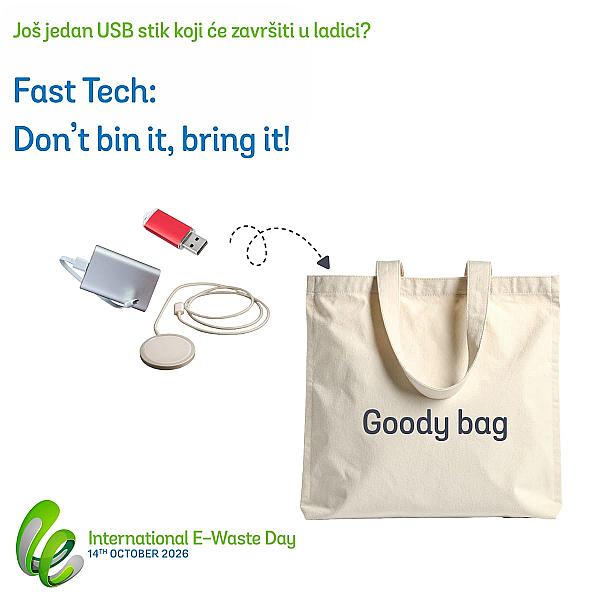
9TH INTERNATIONAL E-WASTE DAY 2026 | OCTOBER 14 "Fast Technology"
--opt.jpg)
"Fast Technology" Increases the E-Waste Problem as Millions of Small and Cheap Electronic Devices Flood the Global Market
A survey on the occasion of International E-Waste Day shows: almost 90% of European consumers own "fast technology" products, 29% store unused devices at home, and 27% dispose of them exclusively through waste streams. Experts call for the recycling of every unused electrical and electronic device.
Brussels – Ahead of the annual Black Friday sales and holiday shopping, the ninth International E-Waste Day 2026 draws attention to the rapid growth in trade in "Fast Tech" products: USB adapters, mini fans, LED lights, electronic toys and other small, low-cost devices.
New research shows that almost 90% of European consumers from 12 countries own at least one such device, and 78% have bought one in the past year. However, when they become obsolete, break down or are no longer needed, many end up in mixed municipal waste or remain forgotten in drawers instead of being handed over for recycling.
This fast-growing and largely neglected waste stream has been called "fast technology" by analogy with easily accessible, cheap fashion: products that are often used for a relatively short time and are easily replaced.
A consumer survey on fast technology, conducted for the WEEE Forum by Bellegarde Scientific Consulting on a sample of 10,245 adults in 12 European countries, showed that the purchase of these products has become commonplace. It is driven above all by low prices, convenience and modest expectations in terms of durability.
The findings suggest that consumers often consciously accept an unwritten compromise: the product is cheap, serves its purpose for a while and is easy to replace.
As many as 58% of shoppers can recall high-speed technology products that they have used for a maximum of six months, including 39% who remember a product discarded without using it, after just one use or within a month. Still, 61% of consumers of these products are generally satisfied, and only 8% are dissatisfied.
A separate survey by Material Focus found that more than half a billion small high-tech products were purchased in the UK alone – about 16 pieces per second.
The WEEE Forum warns that in the coming weeks, with Black Friday promotions and the festive season, another wave of shopping will follow, with many products sold through online platforms.
"Fast technology is the blind spot of the e-waste world," says Pascal Leroy, CEO of the WEEE Forum, which is leading the global International E-Waste Day campaign, organized for the ninth year in a row together with members around the world.
"Black Friday and the holidays will bring another huge wave of electronic toys, decorative lights, mini devices, chargers and other cheap electronics to our homes. Their low price does not mean that they have no environmental price. When they are no longer in use, they need to be collected and recycled."
Consumers expect a short lifespan, but continue to buy
The research reveals an obvious paradox: consumers value longevity, but the convenience and low cost of fast technology often outweigh it.
The environmental consequences of this cycle are less obvious to consumers than the trade-off in terms of durability. While 46% expect these products to have a shorter lifespan compared to more expensive alternatives, only 21% think they are more harmful to the environment. Only 16% associate fast technology with both a shorter lifespan and greater environmental damage at the same time.
"Consumers understand very well that a cheap electronic product may not last forever," says Dimitri Naczaj, co-founder of Bellegarde Scientific Consulting in France. "It is visible what happens when millions of individual purchase decisions turn into millions of discarded cables, headphones, lights, toys and appliances."
What happens when high-speed technology products stop working?
The study did not identify one dominant way of dealing with unwanted high-speed products.
The most common response was to keep the devices at home, which is reported by 29% of customers. Only 27% took the products to recycling centers or utility facilities, while 19% used pick-up points in stores.
Improper disposal is also widespread: 23% of respondents state that they dispose of these products in household waste, 21% in plastic recycling containers, and 7% in street bins. A total of 27% of customers indicated exclusively methods of disposal via waste streams, while 32% indicated exclusively methods of recycling or reuse. Note: for individual survey questions, it was possible to select multiple answers.
It is particularly striking that improper disposal is not always intentional. Among those who reported only landfilling, 21% also cited environmental protection as the reason for such treatment, indicating confusion about where small electronic devices belong. Habit is the most frequently cited reason for choosing how to handle devices at the end of their life, followed by environmental protection and convenience.
European fast-tech buying habits – in figures
· 87% own at least one high-tech product; at least 44% own more than five.
· 78% have purchased a high-speed technology product in the previous 12 months.
• 93% of people aged 18 to 29 have purchased such a product in the previous year, compared to 61% of people over 65
.
• 55% cite low price as the reason for purchase.
• 58% remember at least one product they have used for six months or less.
• 61% are still satisfied with high-speed products overall.
• 80% would pay more for at least part of the product to get a longer-lasting alternative.
• 59% would replace a broken high-speed product with another low-cost product.
• 29% store unused high-speed technology products at home.
• 27% use only disposal, 32% exclusively recycle or reuse, while 16% keep appliances at home.
• 21% believe that fast technology is more harmful to the environment than more expensive alternatives; 15.9% believe that it is less harmful.
• 57% do not know that online platforms that sell electronic devices are legally obliged to contribute financially to the collection and recycling of e-waste.
• 64% do not intend to reduce the purchase of high-speed technology products.
The study found particularly pronounced differences between age groups. Among respondents aged 18 to 29, 93% bought fast technology in the previous year, and this proportion is gradually declining to 61% among people aged 65 and over.
There is also little evidence of social pressure to discourage this trend. Only 14% expect people important to them to disapprove of buying fast technology, while almost half of respondents believe that people are buying more of these products than before. Almost three-quarters of shoppers encounter high-speed technology products at least once a week.
If you sell, help and recycle
WEEE Forum highlights a growing systemic problem: electronic devices are also sold online by companies that may not be registered under national producer responsibility regulations.
If sellers do not meet their obligations, prescribed recycling fees may not be paid, waste collection obligations will not be met, and collection and recycling systems must dispose of products after use without adequate funding.
New research points to low public awareness of these responsibilities. Only 29% of those surveyed knew that online platforms selling electronic devices have a legal obligation to contribute financially to the collection and recycling of e-waste. A further 14% have heard of this obligation but did not know the details, while 57% did not know about it.
"The principle should be simple: if you make money by selling electrical and electronic products in a country, you should contribute to the costs of collecting and recycling them when consumers stop using them," says Leroy.
"Responsible manufacturers are already paying funds into these systems. Online marketplaces should not be a workaround for electronics to enter the market without anyone taking financial responsibility for what happens after they have been used."
The WEEE Forum stresses that this is both an environmental issue and a fairness issue. Companies that comply with the requirements of extended producer responsibility bear costs that their non-compliant competitors can avoid, which can put responsible companies at a disadvantage.
"Consumers shopping online during Black Friday should not be investigating whether every retailer is compliant with environmental regulations," says Leroy. "Platforms that facilitate sales have a significant ability to ensure sellers comply with the rules and cover the cost of recycling the products they sell."
Small appliances, big risks
Although 83% of consumers surveyed know that small products contain electronic components, the study shows that this knowledge does not necessarily lead to proper disposal.
High-speed products contain plastics, metals and other materials that can be extracted and reused. When they end up in mixed waste, these resources are lost.
An increasing number of such products also contain lithium-ion batteries, which poses an additional danger. If discarded with household waste, battery-powered devices can be crushed or punctured in collection vehicles, sorting or waste treatment plants. This can cause fires that endanger workers, damage equipment and interfere with waste management services.
According to the findings of the battery roundtable organized by the WEEE Forum, 36% of the e-waste operators surveyed reported a battery-related fire in their facilities in the previous year. In France, the number of fires in waste treatment plants related to lithium batteries doubled between 2019 and 2023.
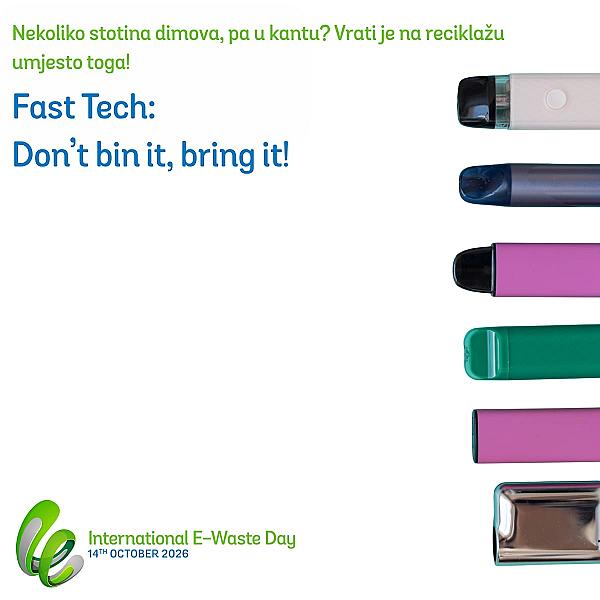
Disposable electronic cigarettes, wireless headphones, small electronic toys and other battery-powered devices are among the products that cause particular concern.
"A tiny device with a battery thrown into household waste can seem insignificant. When this is multiplied by millions of products, the problem becomes serious – both because of wasted resources and because of the risk of fire for the people and facilities that handle our waste," concludes Magdalena Charytanowicz from the WEEE Forum, coordinator of the International E-Waste Day.
Think before you click during Black Friday
International e-Waste Day is celebrated just a few weeks before one of the largest sales periods of electronic devices in the world.
The WEEE Forum encourages consumers to think not only about the price when buying high-speed products during Black Friday and the festive season, but also about whether they really need a new product, whether they can buy a used one, whether it can be repaired and how it can ultimately be handed over for responsible recycling.
For electronics that are already sitting unused in homes, the message is: recognize them, hand them over and demand responsibility that they are recycled by the manufacturer/retailer.
Recognize: anything that has a plug, cable, electronic board or battery should be treated as electronic waste at the end of its useful life, regardless of size or price. It should not end up in mixed municipal waste or ordinary bins.
Hand over: unwanted high-speed technology products should be referred to official collection points, in-store pick-up points or special e-waste locations. In the European Union, retailers, including online retailers, have obligations regarding the collection of discarded electronics. Other circular options include donation, repair and reuse.
Demand accountability: competent institutions, retailers, consumers and online platforms can contribute to ensuring that companies selling electrical and electronic products meet the requirements of producer responsibility and finance the systems necessary for the collection and recycling of the products they place on the market.
ZEOS eco-system: Bosnia and Herzegovina is part of the
global initiative Bosnia and Herzegovina is actively participating in the celebration of the ninth International E-Waste Day through the activities of < href="https://zeos.ba/">ZEOS eko-sistema d.o.o., an authorized operator of the electrical and electronic waste management system in the Federation of Bosnia and Herzegovina and a member of the international organization WEEE Forum.
Through educational programs, information campaigns and concrete actions to collect old electrical and electronic devices, the ZEOS eco-system seeks to bring citizens closer to the importance of responsible handling of e-waste and its role in preserving natural resources. From 2013 to the end of 2025, 32,500 tons of e-waste were collected, and the plan for 2026 is 7,200 tons of e-waste.
Special attention is paid to children and young people through activities in schools, educational workshops, campaigns and e-waste collection actions. In this way, students not only gain knowledge about environmental protection, but also have the opportunity to practically participate in the responsible handling of old appliances.
At the same time, the ZEOS eco-system cooperates with utility companies and local communities, organizes collection actions and informs citizens how and where they can properly hand over defective and unused devices. These activities connect education with the available collection infrastructure at 528 locations and directing e-waste towards appropriate treatment. Through the free e-waste disposal service, recycling is available to legal entities and institutions, and our new service ZEOS E-TAXI provides citizens with free home pick-up for quantities of more than 30 kg.
The message of the ZEOS eco-system is clear: even the smallest devices represent e-waste and a valuable source of materials. If they end up in municipal waste, the possibility of proper recycling and return of raw materials to the economy is missed. That is why it is important to hand over old devices to designated places, and not dispose of them together with other household waste. A map with all locations of containers and recycling yards is available through our website www.zeos.ba or at the link here.
With its participation in the international initiative and activities throughout the year, ZEOS eco-system contributes to the transfer of European good practices to Bosnia and Herzegovina and the development of the circular economy.
The global campaign
International E-Waste Day is celebrated every year on October 14. It was launched by the WEEE Forum and its members in 2018. The initiative brings together e-waste collection systems, producers, recyclers, retailers, governments, local communities, universities, NGOs, schools and consumers to raise awareness and encourage responsible collection and recycling of electrical and electronic products.
Organizations around the world are invited to mark October 14 with collection actions, public events, school activities, social media campaigns, research presentations and other initiatives.
In 2025, more than 140 organizations from 50 countries on six continents participated, with an estimated 1.8 billion potential media impressions in 55 countries.
About the WEEE Forum
WEEE Forum is an international association of producer responsibility organizations that responsibly manage the collection and treatment of waste electrical and electronic equipment. Its members work to improve e-waste collection, recycling, resource recovery and circularity, and promote effective extended producer responsibility for electronics.
Media contact in Bosnia and Herzegovina
ZEOS eko-sistem d.o.o. | Mahir Bjelonja, Marketing and Project Coordinator | mahir.bjelonja@zeos.ba | +387 33 846 317 | www.zeos.ba
---opt.jpg)
--opt.jpg)
--opt.jpg)
--opt.jpg)
--opt.jpg)
--opt.jpg)
--opt.jpg)
--opt.jpg)
--opt.jpg)
--opt.jpg)
--opt.jpg)
-square.jpg)